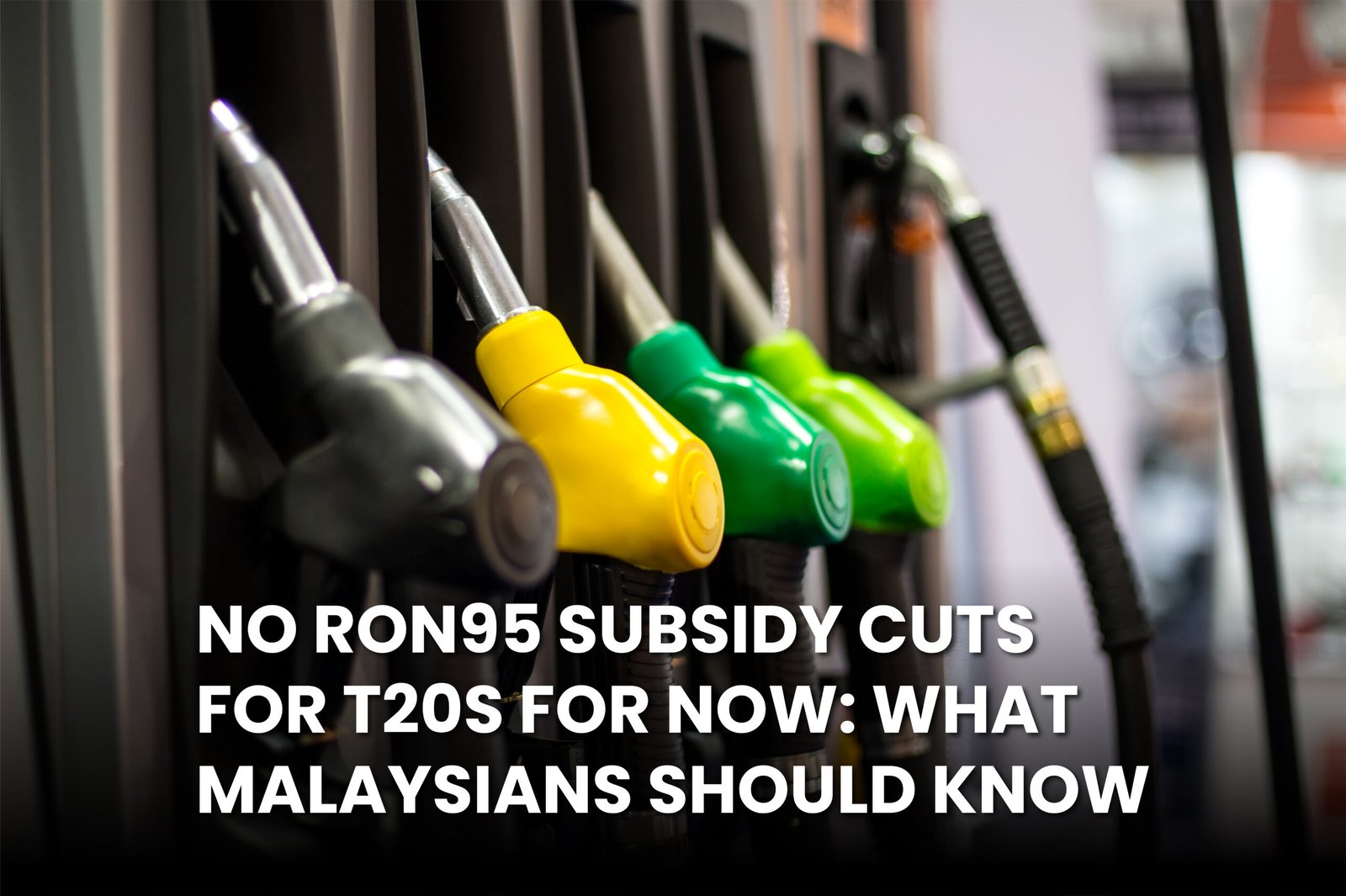
Malaysia’s RON95 petrol subsidy has become a trending national topic again after the government clarified that there are no plans for now to cut fuel subsidies for the T20 group.
Transport Minister Anthony Loke said the Budi Madani RON95 programme, also known as BUDI95, remains available across household income groups for now. He said the government needs a simple and straightforward system to manage fuel subsidy matters, especially at a time when fuel prices and cost-of-living concerns remain closely watched by the public. Source: The Star
The clarification came after recent discussions about whether Malaysia should further rationalise RON95 petrol subsidies for higher-income groups, including the T20, T15, T10, or even the top 5% of earners. Prime Minister Datuk Seri Anwar Ibrahim had earlier said that a proposal for more comprehensive targeted subsidies was still being refined and expected to be finalised soon. Source: New Straits Times
Fact-Check Summary
-
Is the T20 group cut off from BUDI95 now?
No. Based on the latest statement, the government has no plans for now to cut off the T20 group from BUDI95. Source: The Star -
Is the RON95 subsidy review still happening?
Yes. The government is still refining a proposal for more targeted RON95 subsidies for higher-income groups. Source: New Straits Times -
What is the current BUDI95 monthly quota?
The Ministry of Finance said the BUDI95 monthly eligibility ceiling was temporarily adjusted from 300 litres to 200 litres per month from April 2026, while the subsidised price remained at RM1.99 per litre. Source: Ministry of Finance Malaysia
What Is BUDI95?
BUDI95 is the government’s targeted RON95 petrol subsidy mechanism under the Budi Madani framework. The programme is part of Malaysia’s effort to provide fuel assistance to eligible Malaysians while reducing subsidy leakage and improving how public funds are used.
RON95 petrol is one of the most widely used fuels in Malaysia. Because it affects daily travel, household expenses, transport costs, delivery costs, and business operations, any discussion about RON95 subsidy changes often receives strong public attention.
For now, the key point is simple:
The government has not removed RON95 subsidies for T20 households at this stage.
This means Malaysians across household income groups can still access subsidised RON95 under the existing BUDI95 arrangement, while the government continues to review how future subsidy targeting should be implemented.
Current BUDI95 Quota
In March 2026, the government announced that the monthly BUDI95 eligibility ceiling would be temporarily adjusted from 300 litres to 200 litres per month starting April 2026. The Ministry of Finance said this adjustment was a temporary measure until global supply conditions stabilise. Source: Ministry of Finance Malaysia
The Star also reported that the 200-litre monthly quota would be maintained for now amid the global supply situation. Source: The Star
Why Is the RON95 Subsidy Being Discussed?
Malaysia has been reviewing subsidy spending as part of wider efforts to manage government finances and ensure public assistance reaches those who need it most.
Fuel subsidies are costly because they help keep petrol prices lower for consumers. However, critics argue that blanket subsidies can benefit higher-income groups more because wealthier households may own more vehicles or consume more fuel.
Supporters of targeted subsidies say government savings could be redirected toward lower- and middle-income households, healthcare, education, public transport, or other forms of social support.
At the same time, any sudden change to petrol prices can affect public sentiment because many Malaysians rely on cars and motorcycles for work, school, business, and daily errands.
Why No Cut for T20s Yet?
According to the latest statement, the government is keeping BUDI95 available for all household-income groups for now because the system needs to remain simple and manageable. Source: The Star
This is important because fuel subsidy targeting is not only about income level. The government also needs to consider practical issues such as:
- How to identify eligible users accurately
- How to prevent misuse or subsidy leakage
- How to avoid technical problems at petrol stations
- How to protect middle-income households from sudden cost increases
- How to manage drivers with high fuel needs, such as long-distance workers
- How to avoid increasing inflation and transport costs too quickly
What Could Happen Next?
Although there is no immediate cut for T20s, the wider discussion on targeted fuel subsidies is not over.
The government is still reviewing how to make the subsidy system more targeted. New Straits Times reported that the proposal is being reviewed by the Crisis Management Task Force under the National Economic Action Council, chaired by Tan Sri Mohd Hassan Marican. Source: New Straits Times
Based on public discussion and recent reporting, possible future approaches could include:
-
Income-based targeting
Higher-income groups may receive less subsidy or pay closer to market price. -
Usage-based limits
Subsidised fuel may be capped based on monthly consumption. -
Vehicle-based rules
The system may consider vehicle type, engine capacity, or vehicle ownership patterns. -
Hybrid eligibility system
The government may combine income, fuel usage, and other data to decide who qualifies.
At this point, no final model has been officially confirmed.
Economists’ Views on Removing T20 from BUDI95
The debate gained attention after economists suggested that removing the T20 group from BUDI95 could help the government save a significant amount in subsidy spending. Free Malaysia Today reported that one economist estimated excluding T20 households from BUDI95 could save around RM1.5 billion a month. Source: Free Malaysia Today
However, this remains an economic proposal and not a confirmed government policy. The government’s latest position is that BUDI95 remains available to all household income groups for now while the wider review continues.
How Malaysians Are Reacting
Public reaction has been mixed. Some Malaysians support removing subsidies from high-income groups, saying government assistance should focus on the B40 and M40 communities. Others worry that income categories such as T20 may not fully reflect real financial pressure, especially for families with high commitments, dependents, housing loans, or long commutes.
New Straits Times reported that members of the public remain divided over possible RON95 subsidy cuts for the T20 group, with some supporting targeted subsidies and others warning that petrol costs affect everyday life and the wider economy. Source: New Straits Times
Concerns from Sabah and Sarawak
The fuel subsidy discussion has also raised concerns in Sabah and Sarawak, where many residents travel long distances and have fewer public transport alternatives compared with some urban areas in Peninsular Malaysia.
The Sabah Progressive Party reportedly urged the federal government not to further reduce fuel subsidies in East Malaysia, saying subsidised fuel remains important for families and economic activities in areas where travel distances are large. Source: The Star
Diesel Subsidy Discussions Are Also Ongoing
The RON95 discussion is happening alongside wider fuel subsidy discussions. Communications Minister Datuk Fahmi Fadzil said the Cabinet is studying the implementation of a diesel subsidy mechanism aligned with the BUDI95 system. Source: The Star
This shows that fuel subsidy reform is not limited to RON95. The government is also looking at how to manage diesel subsidies, supply stability, and targeted assistance more effectively.
What It Means for Drivers
For now, everyday drivers do not need to make any immediate changes because the government has not announced a cut to RON95 subsidies for T20 households.
However, Malaysians should continue following official updates because subsidy policy may still change once the review is completed.
Drivers may also want to prepare by:
- Tracking monthly petrol usage
- Planning more efficient routes
- Using public transport where practical
- Maintaining vehicles for better fuel efficiency
- Avoiding unnecessary idling or heavy acceleration
- Monitoring official government announcements
Why This News Matters
RON95 petrol is closely tied to the cost of living in Malaysia. Any change in fuel subsidies can affect household budgets, transport costs, delivery charges, business expenses, and inflation expectations.
The government’s latest clarification may provide short-term relief to drivers who were concerned about immediate subsidy cuts. However, it also shows that Malaysia is still moving toward a more targeted subsidy system in the long run.
The challenge will be finding a balance between reducing government spending and protecting Malaysians from sudden cost increases.
Conclusion
For now, Malaysia has no plans to cut off the T20 group from BUDI95 RON95 petrol subsidies. The existing system remains in place while the government continues to refine its approach to targeted fuel assistance.
The discussion is likely to continue because petrol subsidies involve both economic policy and everyday household costs. Malaysians should stay updated through official announcements and reliable news sources before making assumptions about future fuel prices.
Ready to Move Your Business Forward?
At Eternity Group, we provide practical and dependable business solutions that help organizations improve efficiency, strengthen market presence and move forward with clarity.
Contact Us: +6010 663 1648
Location: Bangsar South, Kuala Lumpur